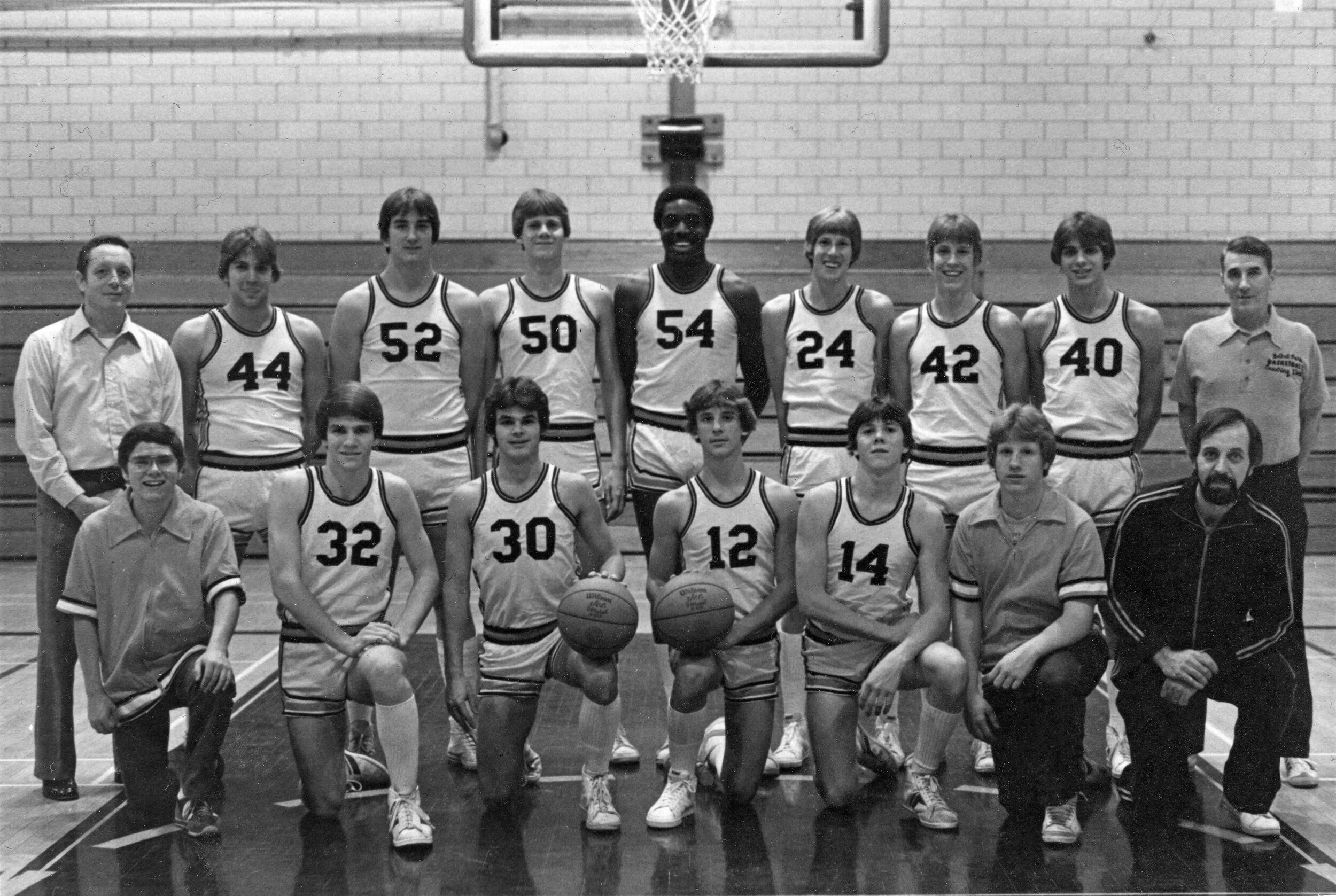
Look below at this high school team photo and select the player that would go on to play thirteen seasons in the NBA. Now take another look at the picture. What player would you choose to become your friend? If you chose number 54 as the answer to the first question, ask yourself how you came to that conclusion. If you did not choose number 54 to the second one, ask yourself why. I’ll revisit these responses later in today’s blog.
As you could probably guess by now, number 54 was the correct answer to both questions. Number 54 was Armon Gilliam. Armon went on from high school to UNLV where he still holds the record for the most points scored in a season. He then had a successful career in the NBA, playing for the Hornets, 76ers, Nets, Bucks & Jazz. Armon was a friend of mine. This son of a preacher and a librarian, was genuine, hard-working and could make you laugh to tears. He was also the first black person I ever met.
This is a picture of my sophomore high school basketball team. That’s me, number 50, standing next to Armon in the back row. I grew up in a Northeast Ohio town that was so lily white it was nicknamed “Caucasian Falls”. However in 16 years of residence, I never heard a disparaging word ever spoken about a black person. Not in my house. Not by my friends. Not in my friend’s homes. The quality people that surrounded me was a shield to the blatant racism that apparently existed in my hometown. I have since learned that Cuyahoga Falls was well-known for intimidating any minority that chose to live within the city limits, hence, the label.
I had the privilege of guarding Armon every day after school at team practice. When you are in such close contact with a person, you learn quite a bit about them. In a futile attempt to block Armon’s jump shot, I frequently found my face buried in his armpit. I quickly learned that his sweat was just as salty as mine. I also had many opportunities to see that our blood shared the same crimson color. Armon, being the only African-American on the team, and I, being recently transplanted to the Pittsburgh suburbs, shared the same level of social acceptance. We naturally sat together on the team bus. We shared a strange friendship. I know that we genuinely enjoyed each other’s company and had a mutual respect. However, we never got to the point where we ever invited each other to the house.
Armon tried hard to teach me his basketball skills, but that too, was futile. He literally willed me his jumping skills in his high school testament. However when you have earned the nickname “Buffalo” due to your inability to achieve any significant airspace between your Nike high tops and the court, it was a hopeless effort. What I did learn, is that we had more in common than our skin color would indicate. It went beyond basketball and a love of the music of Quincy Jones, Rick James and the Gap Band. We were both built on similar spiritual foundations, neither of which weakened by racial prejudice.
I recently heard a black comedienne say that the death of George Floyd and the following incidents we have seen displayed on our TV’s are a “white people problem.” I was immediately struck by the inherent racism of this statement. She too is missing the point of all this upheaval. This is not simply a white problem or a black problem. This is an American problem.
Now to revisit the previous questions. Reflect honestly on what influenced your answers. Each one of us must take a sincere look into our hearts and determine what biases guide our actions. What unconscious decisions do we make about each other regarding the color of each other’s skin, religion, gender, sexual preference, weight or political affiliations? If we are honest with ourselves, we will probably find that we are not free of prejudice.
Prejudice is dividing our country. The red and white stripes on our flag, although distinct, exist side by side. They form a symbol of our continuing effort to form a more perfect union. We must be conscious of the forces that are purposely fueling our biases. We must understand that what makes this country great is not the size of our economy, strength of our military or our “beautiful laws”. What makes this country great is freedom, equality and opportunity for all. If we do not take action to stamp out this intolerance, we may find that our flag has unraveled into an indiscernible pile of thread, lying next to the broken glass and boarded-up buildings.